KOMARNA Sightseeing
| |
| |
 Dubrovnik
and places along the road
Dubrovnik
and places along the road
One word: Go!
 It is tempting to
spend every day of your vacation on the beach. Even so, do allow
yourself at least one excursion.
It is tempting to
spend every day of your vacation on the beach. Even so, do allow
yourself at least one excursion.
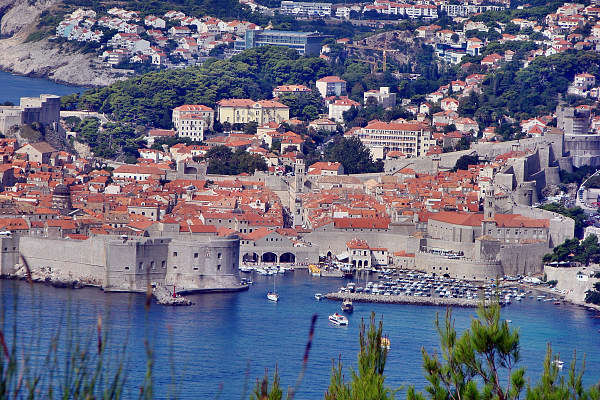
Dubrovnik is one of the first places admitted to United Nations UNESCO Heritage Site. The reason for appointing these is "Protecting natural and cultural properties of outstanding universal value against the threat of damage in a rapidly developing world", as the UN puts it.You must go! This old city is unique and a small wonder that it has survived.
The city can trace its origins back to the first Greek settlement in
Cavtat (about 400 B.C.). When the Avar and Slavic tribes invaded in
614 the population moved from Cavtat to the present place where they
could build a strong fortified city. The city was an important factor
in the Mediterranean trade for centuries where it always retained some
degree of independent through shifting rulers of the area. A bad earth
quake on April 16 1667 destroyed much of the town and killed some 3000
people, half the population. After that it never fully recovered its
former status. You do not have to be interested in history or
architecture to enjoy Dubrovnik. Being a university town it is a
"young city" with numerous concerts, theatre, opera, shops, markets
and greater scores of seafood restaurants than you would expect to
find in a 70.000 population small town carrying a thousand years of
history with pride.
Organize your visit so it does not coincide with the major cruise ships. On this page: Dubrovnik Harbour Cruise Ship Plan
https://cruisedig.com/ports/dubrovnik-croatia/arrivals
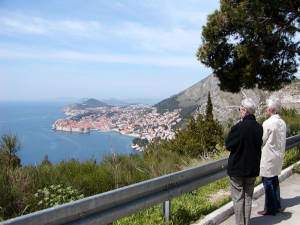
During the Balkan wars from 1991 to 1992 Dubrovnik was bombed from
the surrounding hills and many houses and almost every roof was
damaged. Luckily, the low caliber weapons used did not impact more
than it was possible to restore everything. Standing on higher ground
you will notice the new red tiles on the roofs around the city.
Those places are where the shells impacted.
We recommend that you visit Dubrovnik Online Travel Guide.
Suggested things to do:
Walk the town walls (must do!), visit the Dominican Monastery (near
the Ploce Gate), and visit the Franciscan Monastery and the old
pharmacy (near the Pile Gate). Visit Rectors Palace and - maybe the
Nautical Museum - both are close to the old harbour.
If you have the time, the small evergreen Island of Lokrum is worth a
visit. It is just 10 minutes from Dubrovnik by boat. The Island has
subtropical vegetation with beaches and wonderful footpath along
lovely coves. There is a Benedictine monastery along with a 10m deep
small lake called the Dead Sea.
The fort (Srd) on the mountain above Dubrovnik is also worth a visit
and a good restaurant which must have the best view in Croatia. You
can go up by cable car near Ploce gate, or you can drive up by car.
The road is narrow, but there is lay-bays that will enable cars to
pass each other. Drive towards the airport 1.7 km and turn left
towards Bosanka. From there it is 2.8 km to the fort. There is a good
view from the big white cross, and try to drive to the back of the
fort, go through the wall, turn right and maybe visit the exhibition
for the homeland war and walk all the way round to the front where you
have a fantastic view of the city.
Parking in Dubrovnik: Be aware that parking is always a
problem and that if you are lucky to find a parking space you must buy
a ticket. Tickets (Parkirna Karta) are for sale in all the small
kiosks that sell magazines and from the attendants at the regular big
parking places. On the ticket, you must mark the current date and time
and place it behind the windscreen of your car. There is one place
near the Pile Gate where the cost is 40 Kuna per hour (in 2018) and
because of this it is the most likely place to find a vacant space.
Your best option really is to just go to the big underground parking
that you see going into Dubrovnik from the main road and keeping left
towards the old town.
More information about parking and transport in
Dubrovnik
South of Dubrovnik
Sokol Grad and Konavoski Dvori
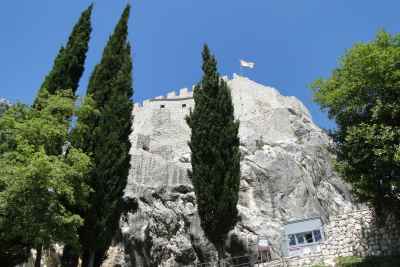
Just after the airport there are two places we recommend you to explore. Restaurant Konavoski Dvori and the area around it and the old fortress Sokol Grad. Both places are easy to find, because there are signs showing you the way.
Drive past the airport to the town Gruda and look out for the signs. Turn left and after a few km keep left for the restaurant or right for the fortress. GPS coordinates are on our GPS page.
At Konovoski Dvori, there are really good opportunities for walking
along the small river, and the food is excellent. It is under same
management as Proto and Nautika in Dubrovnik, and not so expensive.
Try their lamb or veal baked under the iron bell.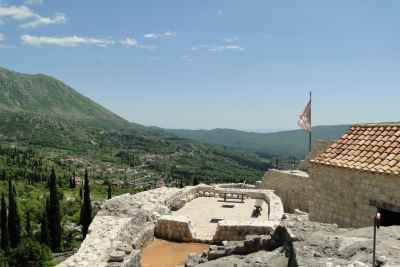
Sokol Grad fortres was controlling the old caravan route to Bosnia and
Monte Negro and has been a fortification since ancient times. In the
1400s, it was taken over by Dubrovnik and got its present shape. There
was a small but efficient garrison here, and it was never conquered.
It is believed to have been abandoned few years after the big
earthquake in 1667 when Dubrovnik had many problems and were forced to
concentrate on rebuilding their city. Over the years, local people
used the fort as a stone quarry - as was customary - and used the
stones for their houses. Now the fort has been very nicely restored
and houses an interesting collection of artifacts that tell a story
about life in the fort. Entrance fee is 40 Kuna (2014).
Sightseeing on the Way to or from Dubrovnik
Ston and Mali Ston
 At the root of
Peljesac Peninsular you find two small fortified towns. Both were
build in the beginning of 1300's by the Republic of Dubrovnik. The
length of the wall around them is about 5 km, and about twenty
bastions have been preserved. It was built to protect the salt
production which is still going on in the valley. Ston is a great
place to start out if you want to walk on the walls. You can enter the
wall around Ston from both ends and you can walk all the way to Mali
Ston if you like (mali = small).
At the root of
Peljesac Peninsular you find two small fortified towns. Both were
build in the beginning of 1300's by the Republic of Dubrovnik. The
length of the wall around them is about 5 km, and about twenty
bastions have been preserved. It was built to protect the salt
production which is still going on in the valley. Ston is a great
place to start out if you want to walk on the walls. You can enter the
wall around Ston from both ends and you can walk all the way to Mali
Ston if you like (mali = small).
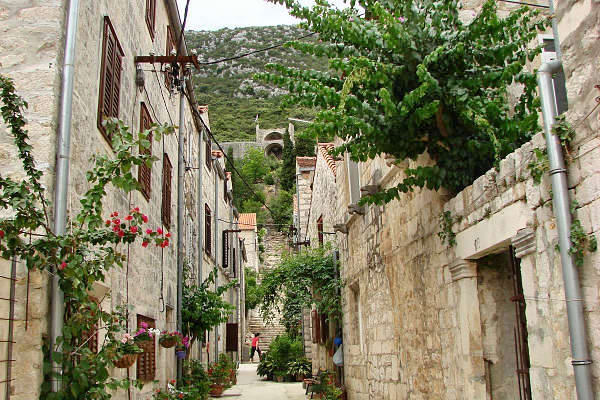
Look at the picture. Look down the street and up to the hill. The small thing 2/3 up is the main gate with walls on each side.
In Roman times Ston was called Stagnum and had an important strategic position. Veliko Kastio (Great Castle), which is a rectangular fortification, is one of the most impressive. It's recommended to start out early before it gets too hot. If you do this you can make it to Mali Ston in time for lunch by the seaside. There is a number of restaurants at the marina serving excellent seafood.
On the hill top in Ston is the Church of St. Michael, which together with the Church of Our Lady, Rector's Palace and the Franciscan monastery is the most valuable cultural monuments.
Ston has a very nice atmosphere and much the same qualities as Dubrovnik - it is just much smaller.
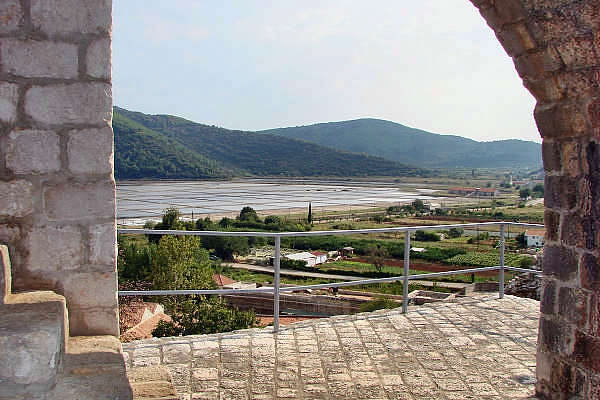 Stock up on refreshments at one of the
cafes, tie your hiking boots and set off from ether end of the wall.
From up there, you can enjoy (and marvel over) the reason these walls
were built: The salty water basins down in the valley.
Stock up on refreshments at one of the
cafes, tie your hiking boots and set off from ether end of the wall.
From up there, you can enjoy (and marvel over) the reason these walls
were built: The salty water basins down in the valley.
If you hike all the way from Ston to Mali Ston you might treat yourself to a taste of the local mussels and oysters that are farmed in the waters between Peljesac and the mainland.
In the Bay of Mali Ston lies the largest clam farms in the eastern Adriatic. Oysters and mussels and other seafood from the Malostonski Bay are known worldwide. Around Ston and on the Peljesac Peninsular there are many opportunities for gastronomic experiences if you like mussels and wine. When you drive into the peninsular you will see many wine yards. Look out for signs that advertise or even better, ask for a guided tour where you have the opportunity to taste the specialties of the area.
The Trsteno Arboretum
 You
can't miss the gardens when you drive through Trsteno about 20
kilometers North of Dubrovnik. The garden has more than 300 species of
trees and numerous plants from around The Mediterranean and the world.
Together with the architecture from the Gothic-Renaissance period this
makes The Trsteno Arboretum one of the finest gardens in this part of
Europe.
You
can't miss the gardens when you drive through Trsteno about 20
kilometers North of Dubrovnik. The garden has more than 300 species of
trees and numerous plants from around The Mediterranean and the world.
Together with the architecture from the Gothic-Renaissance period this
makes The Trsteno Arboretum one of the finest gardens in this part of
Europe.
The botanical garden was founded in 1492 by the Gucetic-family who resided in the splendid 15th century summer residence in the center of the garden until it was nationalized by the communists.
Being able to see the gardens today can be considered somewhat of a miracle. During the homeland war Serbian Navy ships and air planes shelled the gardens with phosphorus bombs on the 2. And 3. of November 1991. To this day, you can still see a few Mexican palm trees that live despite their outer trunks look like charcoal.
There is a splendid view from the bottom of the park. From the main
road follow the signs for Camping and just keep going down. At the end
of the road there is a small harbor and some abandoned houses. They
are not abandoned because nobody wants them, but because it is
difficult to establish ownership.
What about going by Napoleon's Road back from Dubrovnik?
From Trsteno to Slano
In Trsteno - just after you have passed the Botanical Garden; turn right towards Majkovi. Follow this road and experience some great views of all the islands. At three points along the road, you may be in doubt:
- Do not turn towards Dubravica - keep left.
- The next time is when the road divides after you have passed Majkovi, keep right (left leads down to the coastal road before Slano).
- When it divides again keep left. There is a road sign (only readable after you have passed it) showing Vjetrenica. Do not follow it unless you want to visit the caves. It leads past a border station into Bosnia-Herzegovina.
- Keep left and eventually you will arrive at a T-junction very close to the coastal road.
If you are up to more you can keep on going straight ahead into the "Slano to Neum" description and continue from: "After 4-5 km keep left" - or you can turn left now and join the coastal road again.
From Slano to Neum
- Turn right after Slano and follow the road up into the mountains.
- Turn left in the first junction.
- After 4-5 km keep left. The main road appears to go right, but it only leads to the village Mravinica. Keep left.
- At some point later along the road you may think you have lost your way because the road seems to end in a stone quarry - just keep going through the quarry, and you hit a better road on the other side
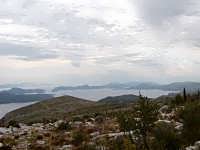
Now you get to the top of the mountain range with a good view. There is a new road coming up from around Doli here. In a junction with signs for Podimoc (to the rights) And Dubrovnik (to the left) you can turn left if you want to go back to the costal road through the village Doli.
If you continue through the junction you will meet another road on your left with a sign saying "Dubrovnik". Just before the road there is a new war memorial on your right. Both from the memorial and from the road there is a good view of the Bay of Ston and you can see the border station in Neum. I suggest you turn left and drive down to the border station here. You may continue, but there is not much to see, and if you meet a strict custom official when you reach the border to Neum, he may decide that you cannot enter because this is not an international border crossing.