KOMARNA Sightseeing
| |
| |
 Peljesac
Peninsular. Sightseeing and wine information
Peljesac
Peninsular. Sightseeing and wine information
A Trip to Peljesac
The bridge from Komarna has made visit to Peljesac and its many nice places much easier.
The Peninsular is a mountainous region with the highest point at 961m. Most of the Peninsular belonged to the Republic of Dubrovnik from the 1400's until 1808 while the western part belonged to The Republic of Venice.
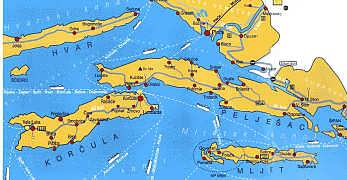 There is basically just one
road going east to west, but since the bridge opened in 2022 there is
a fast road from the bridge towards Dubrovnik and a parallel old road
that continues past the road.
There is basically just one
road going east to west, but since the bridge opened in 2022 there is
a fast road from the bridge towards Dubrovnik and a parallel old road
that continues past the road.
Peljesac Bridge
The great through parts to the southern can avoid the borders and save of time going south to Dubrovnik it is easy to and to the lovely old town of Korcula.
The road from Ston to Orebic
If you start out going east to west, the first "must-see" places you arrive at is Ston and Mali Ston. Both are fortified towns build in the beginning of 1300's by the Republic of Dubrovnik. The length of the wall is about 5 km, and about twenty bastions have been preserved. It was built to protect the salt production in the valley. There is more information about them in the "Dubrovnik trip" page.
Going west from Ston you will soon see the wine fields where the
typical low-stemmed vines are grown in the traditional fashion. There
are offers of wine tasting and sales in many places, but I suggest
that you continue west until you reach the settlement of Potomje which
is at the edge of the wine growing area that is protected by the
government. Only the indigenous Plavac Mali grape grows here.
From Ston, there is only a short way to Prapratno where a ferry
terminal was opened April 2006. The car ferry to Sobra on the Island
of Mljet leaves from Prapratno three times a day.
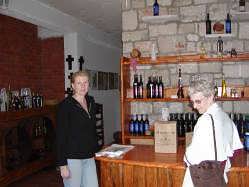
Along the main road through Peljesac there are numerous places that offer wine testing. We can recommend a few of them.
- Milos, nine km from Ston on the right side of the road (expensive and a nice cellar)
- Grgic on the road into Trstenik (very expensive and famous)
- Antunovic in Kuna (great konoba and good food)
- Spaleta in Kuna (The best wine we have found in Croatia at a reasonable price)
- Matusko in Potomje (one of the biggest, well organized and good selection)
Half way up to the end of the peninsular at the eastern cost facing Komarna on the mainland you may find a nice beach bar. The bar has good, fresh and very tasty mussels at reasonable prices. You can also buy them by the kilo and prepare them yourself.
After the beach, the road starts to move up and through Janjina. In Gradina above the village, there is an Illyrian hill-fort. Near the church of St. Stephen, there are walls of a Roman villa rustica and burial stones from the 1st century. The village has several nice captain houses from the 19th century.
After having passed through Janjina you pass the road on your left to Trstenik where the famous wine farmer, Mr. Grgic has his cellars and where a catamaran ferry may leave for the national park on Mljet (only high season).
Kuna
On your right after Trstenik and having passed over the top of the mountain there is a road leading to Kuna village. The families here are almost all into wine production, and can trace their ancestors 16 generations back. Follow the road for 2.5 km to a cross-road where there is a large Fransiscan monastery to the left with the biggest church outside Dubrovnik and to the right, 300m and past a church you can park at the village square. Then walk down the road and you will find Spaleta on the left and Antunovic on the right. During WWII the village was severely destroyed by the Italians, but the houses have been rebuild in original style and are more than 200 years old.
Crkvice Village
Turn off the main road if you want to visit a small and secluded settlement on the coast facing Ploce. Take the road to the right one km before you reach Potomje in the direction of Kuna, which is a small village with a couple of big churches. When you reach Kuna, there is a road turning left to a Franciscan monastery with the biggest church outside Dubrovnik.
To go to Crkvice turn right into Kuna, go straight ahead and keep right against Crkvice. There is a sign on the road. After you have turned right the road goes up a little and 1.5 km through a pine forest.
Then it starts to climb down the north side of Peljesac. 6.5 km with 23 serpentine turns. Cars can only pass each other here at the turns so look out! It is common that the car going up should reverse to the previous turn and let the car going down pass.
At the end of the road, you will be rewarded with a lovely little harbor, a view of the Neretva Estuary and even a clear view to Komarna.
Potomje
The best wines grow to the west of Potomje behind the mountains. In older times the people of Potomje had to travel more than 20 km to get to their wine fields. Today they use a tunnel that has been blown through the mountain. You will see the tunnel straight ahead if you turn left towards the first farms in Potomje (coming from the east). Try to drive through the tunnel, and you will be rewarded with a great view of the Adriatic and the Islands of Mljet and Korcula - and theoretically you can see all the way to Italy.
One of the big wine producers is Mr. Matusko. You can taste and buy his wines in a house close to the tunnel. There is a selection of both red and white wines at reasonable prices.
If you continue on to the town of Orebic, the best-known tourist resort on Peljesac, there is a ferry to the Island of Korcula. You can make a quick trip with the passenger-only ferry to Korcula City, but maybe you should plan for a separate trip to see more of the island. Dedicate the whole day to the beautiful Island of Korcula. In the City of Korcula, there is a house where Marco Polo is believed to have been born (yes, he was a Croat, and the area was part of The Republic of Venice at the time).
Ferry from Ploce to Peljesac
The ferry leaves Trpanj early in the morning, at noon (not Sunday) and late afternoon - and it leaves Ploce later in the morning, early afternoon (not Sunday) and early evening. The trip takes about an hour and the ticket price is reasonable. You must go to an office and buy your ticket before you enter the ferry.
During July and August there can be many cars waiting, and you must be at the ferry 1-2 hours before it leaves.
Wine from Komarna
The new wine yards around Komarna is their own district, the youngest
in Croatia. The plants are mostly Plavac Mali and Postup as on
Peljesac and Komarna wine is available from Rizman, Terra Madren,
Saints Hill, Deak and Volarevic. Other producers will soon follow.
There are so far (2018) two wineries open where you can sample and buy
the wine and from both there is a fantastic view over the sea.
Rizman Winery is on top of the ridge over Komarna and you can see it from the village. Unfortunately there are no direct path up there, so you have to use a car and go in a big arch around. Go 5.5 km towards Opuzen. Look for a big cross and turn a sharp right towards Slivno Ravno. After 1,5 km turn right at a monument and from here there are signs for the vineyard. You can also taste and buy the wines at the rest stop close to Raba village.
Terra Madre winery is, for some, within walking distance of Komarna. about two km. Go up towards the main road and turn left just before you reach it, keep left and continue along the ridge to the vineyard. Terra Madre produces organic wine in several price ranges and has programs for tastings. It is not necessary to book a tasting time in the high season.
Deak Wines can be tasted and bought at the rest stop on the main road closest to Raba village and bought at the mini market in Komarna.
Saints Hill has its winery on Peljesac where they also produce wine. It is located between Kuna and Trstenik
Volarevic Winery is located in Metkovic on the road to Vid (Narona) and their wine is sold at the plant nursery close by.
Wines from Peljesac
 The
best wines come from the Dingac slopes behind the mountain where the
ground is very stony and where you would not think the chances are big
of producing any kind of crop. Even so, believe me some of the wines
are world class and since the return of Croats, who have learned wine
production in California, the quality has been stable. Go into one of
the places where they offer you samples of their wines. Taste them -
and try also to taste the more expensive ones. If you enjoy wines and
maybe even has it as a hobby, you will be able to taste something that
is still quite rare in Europe, but is sure to gain respect over the
next few years.
The
best wines come from the Dingac slopes behind the mountain where the
ground is very stony and where you would not think the chances are big
of producing any kind of crop. Even so, believe me some of the wines
are world class and since the return of Croats, who have learned wine
production in California, the quality has been stable. Go into one of
the places where they offer you samples of their wines. Taste them -
and try also to taste the more expensive ones. If you enjoy wines and
maybe even has it as a hobby, you will be able to taste something that
is still quite rare in Europe, but is sure to gain respect over the
next few years.
The typical Dingac is a strong, dry red wine with 14% alcohol content, but there are several variations, and they also produce some good white wines (the best one I have tasted for years - actually).
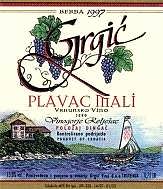
If you want to taste the most famous Dingac wine you have to go down towards the little town Trstenik - that is well before you get to Potomje at the eastern edge of Dingac district. Half way down from the main road on the left you find the house of Mr. Grgic. He makes one red wine and be warned - it is expensive, 250 Kuna when we last checked - per bottle (in 2015). Hefty, but I promise you it is something quite unique.
The wines from the area west of the Dingac District are called Postup. It is the same grapes, but very different wines.
Wine in South Dalmatia
Important words to remember when you "decode" the labels:
- Bijelo vino = White wine
- Crno vino (black) = Red wine
- Crveno vino (red) = Red wine
- Stolno vino = Table wine
- Kvalitetno vino = Quality wine
- Vrhunsko vino = Excellent wine
- Suho = Dry
Croatia has a long tradition for wine making and most of it is still produced from small private wine yards and consumed by the farmer's family and friends. Everybody in Dalmatia has their own secret place where they get "the best wine" from and some of it is amazingly good. The problem is, however that as it is fermented and produced by traditional methods it is impossible to maintain a reasonably predictable quality. Some years it is very good and some it is terrible.
On the Peljesac Peninsula, we find a good example of excellence in the small village Trstenik where Mr. Miljenko Grgic has founded Grgic Vina. As a young man Mr. Grgic studied wine making at the University of Zagreb. In 1958 he immigrated to USA with 20 dollars in his pocket and eventually ended up running his own winery in Napa Valley. He returned to Croatia in 1996, and he now produces some of the best wines made on the red Plavac Mali and the white Posip grapes. Both are indigenous to Croatia and specifically Peljesac.
Plavac Mali is also grown in many other places along the Croatian coast - resulting in very different qualities. But the home of the grape is Peljesac and this is where you should visit it and taste it. The Peljesac Dingac may have up to 15% alcohol so you better agree who should drive before you start tasting (Please remember that the Croats have a low tolerance towards drinking and driving. The police have the gear to test you, and they will use it).
 In Potomje, further west from
Trstenik you should visit Mr. Matusko's cellar. Here you have the
option to compare different wines from both Postup and Dingac
districts. You find The Matusko winery south of the main road just
before you enter Potomje. Turn down the road and turn left at the
first big buildings.
In Potomje, further west from
Trstenik you should visit Mr. Matusko's cellar. Here you have the
option to compare different wines from both Postup and Dingac
districts. You find The Matusko winery south of the main road just
before you enter Potomje. Turn down the road and turn left at the
first big buildings.
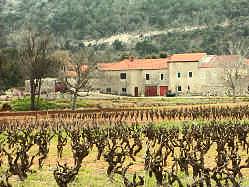
The Plavac Mali wine plant does not quite look the way you may expect. It is kept very low and almost like a bonsai. The reason is that the very hot weather in summer can completely dry out the ground, but with the plants kept low and close together they can keep a proper amount of humidity. If you see plants tied up like they are in Italy and France it is young plants or it is white wine which is more robust and can manage on dry soil.
The historic origin of Croatian wine is probably Greek. The ancient Greeks did not only establish commercial and cultural centers in Dalmatia, they also planted wine. Twenty two centuries ago the Greek writer Athenaios wrote about the wine produced on the Dalmatian island of Vis, Hvar and Korcula. Many jugs and coins have been found from that time with symbols of wine and wine growing. It was an important factor in the economic life of people in the Greek colonies. The tradition around wine growing was continued by the Romans and later the Slavs.
Wine making on Korcula and Peljesac was at times almost a cult and wine was treated as a sacred liquid. There is a statute from 1214 from Korcula that contains strict rules protecting the vineyards.
By: Jan Skov