KOMARNA Sightseeing
|
|
|
|
 Historic
excursions and fortifications
Historic
excursions and fortifications
See also Mostar and around and Hercegovina Trip for other places in Hercegovina.
All over the area of the Neretva Valley, there are remains of the many cultures and civilization that have mixed in the area. Unfortunately very little has been done to excavate and document the remains, and they can be difficult to find if you don't have local knowledge. Croatian law gives little power to the archaeologists and their funds are limited. This is a left-over from the communist administration that hopefully will be changed soon. When it does it will be a formidable gold mine for the tourist industry. On the other hand, when you do find the interesting places you can be safe for souvenir salesmen and tourist busses.
Short History of the Area
The Pre-Croatian Period
We can be certain of habitation as far back as the older Stone
Age, and
it is also assumed that The Cro-Magnon man lived here 13 thousand years
ago. From the later Stone Age period, there is proof of the existence
of
a pre-Illyrian culture. In the older Bronze Age, there is evidence of
Illyrian
tribes. In the second century BC, the Daors allied with the
Romans and waged war with the Illyrian tribes of Dalmatia.
The Roman Illyrian province of Dalmatia had its administration seat in Solin near Split, and from the third century in Narona just outside Metkovic.
Illyrian: There were three Roman - Illyrian wars between 229 and 167 BC. The Romans tried to conquer Illyrian lands, to get rid of Illyrian pirates, which were tolerated by their Queen Teuta. The Illyrians worshipped the life-giving Great Mother and the Sun, which later developed into the adoration of the Greek sun god Apollo. The Cult of the Snake was also important; this animal was sacred in all matriarchal religions in Europe and therefore, became demonized by Christianity. The snake was considered to be the protector of warriors and of the dead. The Illyrian also worshipped the Earth and their ancestors.
The Beginnings of Croatian History
 At the end of the 6th
century,
Croatians began
to establish themselves
in these regions. There are different opinions on where the Croats
originate
from. One story is that they come from Poland, and that they were
invited
into the area to help defend the borders. A fact is that Croatians have
a long reputation for being great warriors. During the Ottoman Empire
most
of Croatia was organized like an army and military law was enforced for
all - men, women and children. When Croatia was part of the
Austro-Hungarian
Empire, there were also special regiments of Croatians that earned
great
respect.
At the end of the 6th
century,
Croatians began
to establish themselves
in these regions. There are different opinions on where the Croats
originate
from. One story is that they come from Poland, and that they were
invited
into the area to help defend the borders. A fact is that Croatians have
a long reputation for being great warriors. During the Ottoman Empire
most
of Croatia was organized like an army and military law was enforced for
all - men, women and children. When Croatia was part of the
Austro-Hungarian
Empire, there were also special regiments of Croatians that earned
great
respect.
From the medieval period, the most famous memorials of the
civilization
in this region are the "stecak" - truly indigenous grave memorials.
Up to the 12th century, this area was Glagolitic (which is a
fascinating
story by it self). Read about the Glagolithic alphabet and more
about history. Have a look at: http://www.croatianhistory.net/etf/et03.html).
The Period of Turkish Occupation
Christianity arrived in the area in the time of the Romans.
Judging by
the amount of early Christian church ruins it was widespread. In large
part the churches were destroyed, and leveled during the time of
the migration in the 6th and 7th centuries. The Croatian
settlers accepted Christianity very early. 
Bosnia-Hercegovina fell under Turkish power in 1463. The Turkish invaders wished to occupy the whole of Croatia too, to reach Vienna and Rome. On their way, the Croatians stopped them; for this reason, the Pope proclaimed them to be the "bulwark of Christianity" and Croatia still to this day has a special relationship with Rome. Croatia, nevertheless, had to pay a high price.
The life of the Catholics under Turkish rule was constantly exposed to the forced passage into Islam, to oppression and to persecution. Under the Turkish feudal system, no Croatian could possess anything immovable. Catholics were permanently considered as enemies of the state, because their head was in enemy territory: Rome.
The Austro-Hungarian Administration and the Creation of Early Yugoslavia
After liberation from Ottoman rule in 1878, the Austro-Hungarian Monarchy took power in Croatia. Croatia was considered a part of Hungary for several periods, and they never managed to establish a truly sovereign state and get some amount of independence. In 1929, the Kingdom of Yugoslavia was established, which was to crumble at the beginning of the Second World War. The kingdom was mainly dominated by the Serbians.
After the war, a new Yugoslavia was born of the partisan movement that was led by Marshal Tito. Tito was a Croat and as long as he lived, he managed to keep the South (Yugo) Slavs together in one state, but there was not much love between the different people and Yugoslavia was never popular with common people. It was an elite dream that could not survive the change of leadership, and today we have a more natural division of the area where the people are able to identify with their common culture and background.
Slivno Ravno and Smrdan Grad
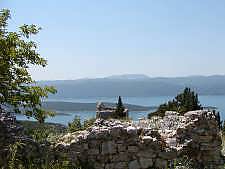 Slivno
Ravno has two churches and Smrdan Grad has one church and the
ruins of a city that was built by the Turks as a protection of the
harbor
in Klek. In 1689 the Venetians took it and later successfully and at a
great
expense stood up against the Turkish army. There is also a rather
unique
Illyrian burial ground in the area. Slivno is one of the oldest
settlements
in the Neretva Delta with many historical and cultural monuments. When
you drive there you see abandoned houses and ruins everywhere and many
signs show that the area was cultivated. Now it has been left and
people
have moved to the delta or to the coast.
Slivno
Ravno has two churches and Smrdan Grad has one church and the
ruins of a city that was built by the Turks as a protection of the
harbor
in Klek. In 1689 the Venetians took it and later successfully and at a
great
expense stood up against the Turkish army. There is also a rather
unique
Illyrian burial ground in the area. Slivno is one of the oldest
settlements
in the Neretva Delta with many historical and cultural monuments. When
you drive there you see abandoned houses and ruins everywhere and many
signs show that the area was cultivated. Now it has been left and
people
have moved to the delta or to the coast.
Smrdan Grad was a medieval fortification build by the Turks in
the beginning
of 1400's to protect the harbor of Klek. The Venetians stole the
fortification
from the Turks in 1699. When the Turks tried to take it back in 1699,
they
lost most of their army. After the fight there were so many dead bodies
that the town got its name (stinking city). The Austrian army last used
the fortress during its occupation of Hercegovina.
Please see
Close to Komarna for driving
directions.
Narona
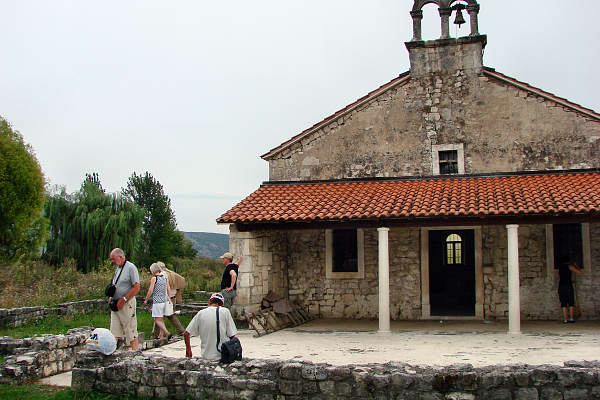 Narona
just
outside Metkovic was a Greek settlement first
mentioned by
the Greek historian Theopompus (Historian for Alexander the Great) in
the
4th century BC. The town continued to be one of the most important
towns
in the area and was eventually promoted to the rank of colony under the
Romans who used the town as a base for attacks on rebel states and on
those
pirates' nests that the island-dotted waters always fostered.
Narona
just
outside Metkovic was a Greek settlement first
mentioned by
the Greek historian Theopompus (Historian for Alexander the Great) in
the
4th century BC. The town continued to be one of the most important
towns
in the area and was eventually promoted to the rank of colony under the
Romans who used the town as a base for attacks on rebel states and on
those
pirates' nests that the island-dotted waters always fostered.
Once rebels and bandits had been eradicated the town's importance grew even further as it became the regions business centre and the biggest town in the eastern Adriatic and the administrative centre of Illyria. Its status lasted until the 6th century when it began to decline to be completely abandoned in the mid 7th century when the Avar tribes destroyed the town and its basilica (the first one in Croatia where people were baptised).
Excavation and restoration is still going on so don't expect to see the likes of Rome or Athens. Keeping this in mind a stroll through the village and along the remains of the once magnificent defensive walls is a nice break from lying around getting grilled on the beach.
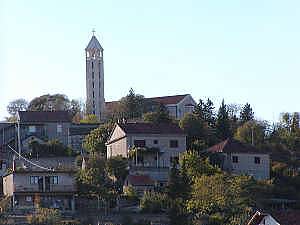 The small
village of Vid is now standing on the ground where
there once
was a town with 100.000 inhabitants. The older houses in Vid are
clearly
build with stones taken from the Narona ruins and in many walls you
will
notice nice fragments of sculptures and other Roman remains. The local
people have found (and sold) many artefacts and even today we have
heard
stories about a black market for antiques.
The small
village of Vid is now standing on the ground where
there once
was a town with 100.000 inhabitants. The older houses in Vid are
clearly
build with stones taken from the Narona ruins and in many walls you
will
notice nice fragments of sculptures and other Roman remains. The local
people have found (and sold) many artefacts and even today we have
heard
stories about a black market for antiques.
When you drive in to Vid,
turn
right and drive up to the post office (left) where you can park the car.
Walk along the old city wall that has never been excavated, first on the left side and later you can walk on stairs that follow the wall up to the new church Madonna of Snow.
Along the walls you can see remains of small chambers that is supposed to have been used as catacombs and the whole area outside the wall is one big burial ground that is very little excavated.
For example, when excavation started 20 years ago on the grave of the Queen of the Roman Emperor Vespatian, the local population managed to stop it because it interfered with their access to the church!
Close to the new church of Madonna of Snow on the top of the hill in Vid, there is a monument that symbolises the Croatian battles at sea. The monument is in honour of Duke Domagoj.
Continue your walk past the West side of the church and go down the stairs along the remains of the wall. You will pass one tower that is used as a regular residence and notice how lots of stones with Roman inscriptions have been used to rebuild the walls.
When you continue down to the village centre you will see the new and modern museum that opened 18. May 2007. The museum is on top of the Roman Forum where the newest excavations was started in 1996. Here the temple (Augusteum) was excavated containing 16 statues of gods and goddesses among which the most impressive is a 3 m high statue of the emperor Augustus in his imperial uniform. The statues are exibited inside the museum.
So much about the town is still not known. When Narona was big, it was subjected to several earthquakes, every time rebuild and every time a "gold mine" was left under the ruins for archaeologist. Hopefully, one day, funds will be allocated so that we may learn more about the town.
Gabela
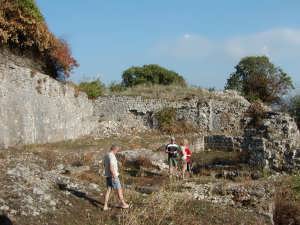 This is the place to go if you're
into ancient
ruins. In Gabela, four kilometres
from Metkovic upstream on the Neretva River and just across the border
to Herzegovina is a small village that has had a very long and troubled
history. Some claim that it is the location of Troy and the Mexican
professor
of archaeology, Roberto Salinas Price, has written about how the area
and
its geography fits with the ancient story of the Iliad.
This is the place to go if you're
into ancient
ruins. In Gabela, four kilometres
from Metkovic upstream on the Neretva River and just across the border
to Herzegovina is a small village that has had a very long and troubled
history. Some claim that it is the location of Troy and the Mexican
professor
of archaeology, Roberto Salinas Price, has written about how the area
and
its geography fits with the ancient story of the Iliad.
After the fall of Narona Gabela fortress was the new Neretvan gate to Bosnia-Herzegovina. Up to the end of the 1100´s it was called Drijevo and was an important centre for the trade between Bosnian kings and the Republic of Dubrovnik. From the 1400´s the name used by others was Gabela (from the Italian word for customs tax).
The Turks occupied Gabela in 1526 and they called it Citluk. In 1694 it was handed over to the Venetians. In 1716 the Venetians moved their centre down river to Fort Opus near Opuzen and Gabela lost its importance.
The locals may tell you that Gabela goes back to pre-historic time and they may very well be right. Very little excavation has been done but Roberto Salinas Price, has found strong evidence that Homer's Iliad takes place around the Neretva Dubrovnik area and that Gabela is no less than Troy. Who knows? - You may find his theory in a book that is available on Google Books.
Driving directions to Gabela and Mogorjelo may be found in Mostar and around.
Mogorjelo
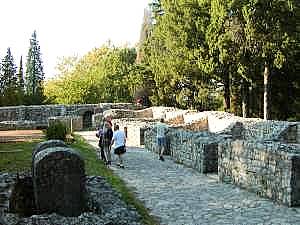 The
remains of a Roman villa rustica from the 200's were excavated between
1899 and 1903. A villa rustica is a large industrial-like farm
supplying
produce to nearby towns. Mogorjelo was the main supplier to Narona.
The
remains of a Roman villa rustica from the 200's were excavated between
1899 and 1903. A villa rustica is a large industrial-like farm
supplying
produce to nearby towns. Mogorjelo was the main supplier to Narona.
Although it is not known it is assumed that it was also used as part of the defence system of Narona. It is a very large ruin, 102 times 86 meters - similar to Diocletians Palace in Split. The Goth destroyed it in the beginning of the 400's and in the end of that century two Christian basilicas were build on the ruins and they also were totally destroyed in the beginning of the 600's during the Avar and Slav invasions.
After the excavation ended in 1903 cypress trees were planted
and the area
is now a beautiful park.
Driving directions to Gabela and Mogorjelo may be found in
Mostar and around.
Fortifications in the area
There are remains of many fortifications around the Neretva River and Delta.
Fort Opus is on top of a hill just outside Opuzen to the right when going towards Metkovic. The fort was build by the Venetians and the last function was as prison during the Austro-Hungarian rule. It is now a ruin and well worth a visit because of the view from the top.
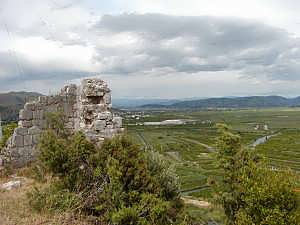 To find the
road to the top
you must go into Opuzen and find Mala Neretva
- the small river that breaks off from Neretva in Opuzen. Follow the
road
along the left bank of Mala Neretva. From the centre of Opuzen and
driving
along the river you pass a small bridge and just after that bridge
there
is a narrow road on your left leading to the top.
To find the
road to the top
you must go into Opuzen and find Mala Neretva
- the small river that breaks off from Neretva in Opuzen. Follow the
road
along the left bank of Mala Neretva. From the centre of Opuzen and
driving
along the river you pass a small bridge and just after that bridge
there
is a narrow road on your left leading to the top.
If you come from Komarna you can also take the road towards Podgradina just after the petrol station and Hotel Merlot and before Opuzen. Follow the bank of Mala Neretva and turn right for Fort Opuz just before the road crosses the small bridge.
Postrednica in the island between Neretva and Mala Neretva at Opuzen there was a medieval fortress build by Dubrovnik to protect their trade interests. It was left and ruined by Dubrovnik when they withdrew to Ston in 1472,
Brstanik is situated above Podgradina near Opuzen. It was build by a Bosnian King in 1382. In 1686 the Venetians restored the fort. As late as World War I it was in use as a prison camp for Russian soldiers. The fort burned down in 1939.
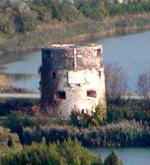 Kula
Norinska
is
where Napoleon Road crossed Neretva close to the Metkovic-Opuzen road.
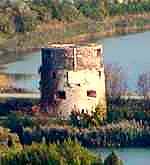
Norinska Kula (tower) was build by the Turks in the beginning of 1400's
and together with the rest of the fort that does not exist any more it
was a defence against Venice. Today the tower and the village are
separated
because the Neretva river bed was changed.
Kula
Norinska
is
where Napoleon Road crossed Neretva close to the Metkovic-Opuzen road.
Norinska Kula (tower) was build by the Turks in the beginning of 1400's
and together with the rest of the fort that does not exist any more it
was a defence against Venice. Today the tower and the village are
separated
because the Neretva river bed was changed.
The purpose of Norinska Tower and fortification was to keep the Venetians away from the valley and to have a stronghold where the Turkish possessions in Bosnia and Hercegovina could be defended. The Turks didn't quite succeed. In 1685 they had to give in to a Venetian siege and leave the area, but with the towers strategic importance the Turks wanted it back. And they got it. Several times in fact. During the next centuries the Venetians and the Turks succeeded one another in being masters of the tower. This rivalry came to an end when both of them were kicked out by Austrian troops.
Under Austrian rule the Norin River altered its course and the tower lost its strategic importance and it was abandoned. The tower is well preserved. There is a sister fortification inside Herzegovina. See under Hercegovina Trip.